

Strengthening the UNESCO Chairs network: advancing collaboration, knowledge exchange and impact
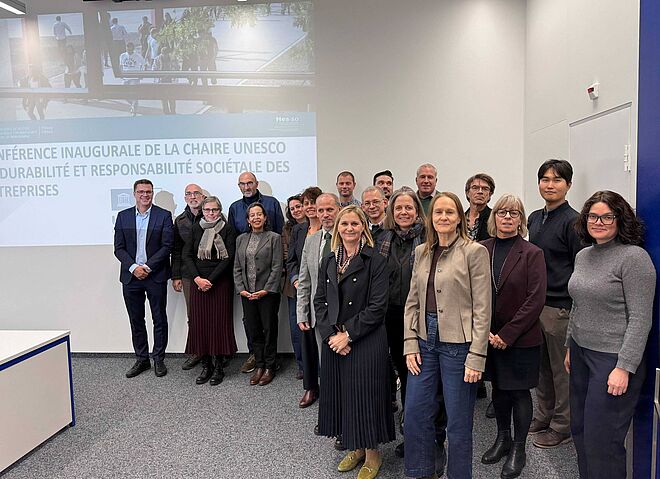
On 18 November 2026, representatives of UNESCO Chairs in Switzerland gathered at the School of Management Fribourg (HEG-FR) for their annual meeting, organised by the Swiss Commission for UNESCO.
Representing the University of Basel's UNESCO Chair on ‘Physical Activity and Health in Educational Settings’, Prof. em. Dr. Uwe Pühse and Dr. Ivan Müller joined colleagues to exchange perspectives on international collaboration, knowledge sharing and future opportunities within the UNESCO network. A key contribution came from Maya Prince, Programme Manager of the UNITWIN/UNESCO Chairs Programme at UNESCO Headquarters, who highlighted opportunities for UNESCO Chairs to engage more actively with UNESCO priorities and its wider global ecosystem.
With more than 1,100 UNESCO Chairs and UNITWIN Networks across over 130 countries, the programme provides a platform for international collaboration. Key priorities include strengthening South-South cooperation, fostering interdisciplinary research, promoting open knowledge sharing and contributing academic expertise to UNESCO events, publications and programme implementation.
The presentation also highlighted practical ways to increase the visibility and impact of UNESCO Chairs, including stronger communication, dedicated webpages, thematic connections with UNESCO focal points and closer collaboration across the global network.
For the UNESCO Chair on ‘Physical Activity and Health in Educational Settings’, jointly anchored at the University of Basel and Nelson Mandela University in South Africa, these priorities offer important opportunities to strengthen international partnerships. Through its work in Switzerland and Sub-Saharan Africa, the Chair connects research, teacher education and community engagement to advance Quality Physical Education (QPE), healthy school environments and UNESCO's Fit for Life initiative.
The meeting reinforced a shared ambition: to translate academic expertise and international partnerships into meaningful contributions to education, sustainable development and societal impact.
Learn more about the Swiss Commission for UNESCO.
Quick Links