

How is Physical Education shaped across Europe? New international study reveals common goals and national differences
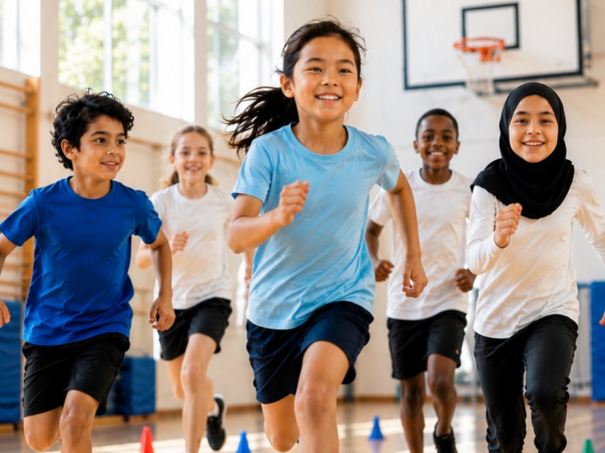
An international study involving the UNESCO Chair examines how Physical Education (PE) is conceptualized in school curricula across Europe. The findings reveal both shared priorities and substantial national differences, offering new insights into the role of PE in education systems and its future development.
What should children and young people learn through Physical Education (PE)? And what role should movement, sport and physical activity play in school education?
These questions are at the heart of a new international study published in the Journal of Teaching in Physical Education. Researchers from across Europe examined national PE curricula to identify the goals and content that shape what is taught in schools. The study shows that PE is understood in diverse ways across Europe. While curricula share important priorities, countries differ considerably in how they define educational goals, select content and conceptualize the contribution of PE to children's and young people's development. This diversity is more than a curricular detail. It highlights an important question for education systems: What do we expect PE to achieve, and how can curricula support these goals in a coherent way?
From physical skills to holistic education
The findings contribute to a broader international discussion about the role of PE in schools. Contemporary approaches increasingly understand PE as extending beyond sport performance and physical fitness. Movement competence, knowledge, motivation, social and emotional development, health and lifelong participation are becoming increasingly relevant dimensions of quality PE.
This perspective closely connects with the work of the UNESCO Chair on "Physical Activity and Health in Educational Settings" at the University of Basel and Nelson Mandela University. The Chair advocates for Quality PE and works at the intersection of research, education, health and international collaboration. Its research activities contribute to the development of evidence-based approaches that support lifelong physical activity and wellbeing.
A European perspective with Swiss expertise
The international study also provides an opportunity to take a closer look at Switzerland. In the Swiss curriculum, the researchers identified five of the seven underlying concepts examined in the study: (1) promoting physical activity for life, (2) health and wellbeing, (3) empowerment or enablement, (4) benefiting society, and (5) enjoyment or fun. Physical literacy, for example, is implicitly or conceptually incorporated, but is not explicitly referred to as ‘physical literacy’ or structured as such.
The Swiss case therefore reflects several of the broader priorities identified across Europe while also illustrating the diversity between national approaches. In particular, the combination of lifelong physical activity and health with empowerment, social contribution and enjoyment highlights that PE can be understood as contributing to more than physical performance alone.
Why curricula matter
Curricula do more than determine what happens in a PE lesson. They express what education systems consider important for the development of children and young people. Understanding these priorities across countries can therefore help researchers, educators and policymakers identify common challenges, learn from different approaches and further develop inclusive, meaningful and future-oriented quality PE.
For further information: Prof. Dr. Kasper Salin, University of Jyväskylä (kasper.j.salin@jyu.fi)
Reference
Salin, K. et al. (2026). Physical education curricula in Europe – The dimensions of goals and contents. Journal of Teaching in Physical Education.
Quick Links